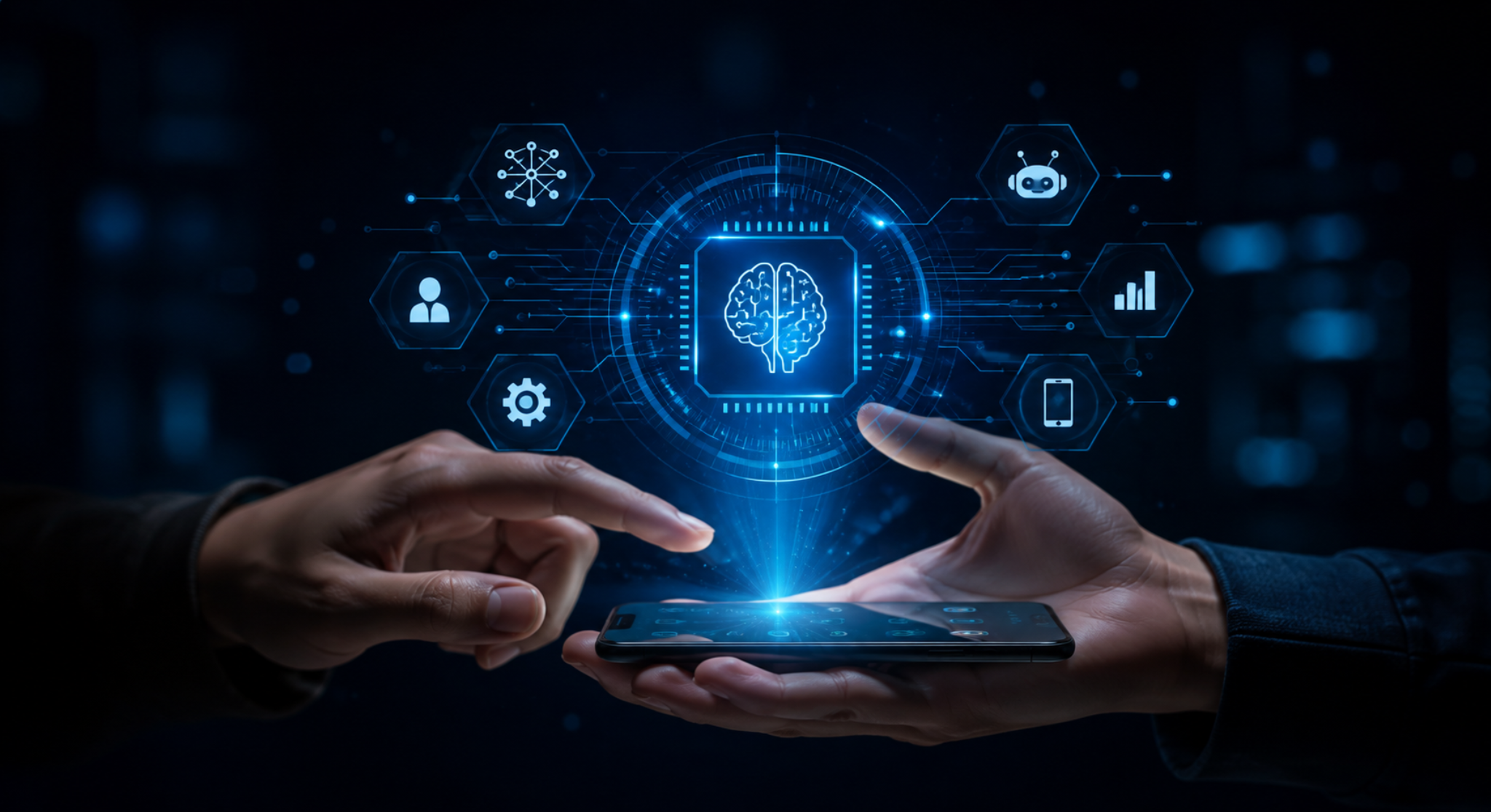
Quick Answer: AI in mobile app development enables on-device processing. It lets you execute machine learning models without cloud dependency. This reduces latency to milliseconds and maintains user privacy. Modern mobile app development frameworks integrate natural language processing, predictive analytics, and AI agents directly into Android and iOS apps.
AI has given modern mobile apps brains of their own. They no longer wait for specific commands to perform restricted actions. They anticipate what users need, remove unnecessary formalities, and learn along the way to improve user experience.
AI in mobile app development has influenced organizations of all scales, from young startups to established enterprises. On-device AI reduces cloud dependency for real-time predictions, reducing delays from server-round trips.
While most mobile AI implementations still send your data to a remote server, on-device machine learning models outperform cloud-based alternatives. They have mastered specific prediction tasks while keeping sensitive user data on the device.
On-Device AI And The End Of Cloud Bottleneck For Real-Time Predictions
Modern users expect mobile apps to respond immediately and accurately. Waiting for all requests to travel to the cloud and return is outdated, especially in business environments that prioritize speed.
What On-Device Processing Actually Does
On-device processing happens when a machine learning model runs directly on a phone or a tablet, and not on a remote server.
Here, the model stays inside the application bundle. When a user initiates an action, the request is processed locally and returns with immediate results. Many AI features may not even need an active internet connection.
This makes real-time predictions much faster.
Such an approach is becoming increasingly common for machine learning app development. The most common use cases include:
- Retail inventory apps with image recognition
- Field service apps with voice commands
- Barcode and document scanning
- Predictive text
- Smart form completion
- Offline translation
- Speech recognition
AI mobile app developers build these experiences using Core ML (for iOS apps) and ML Kit (for Android apps).
The business value of such apps becomes evident in environments where connection is unreliable or unstable. End users like warehouse users, field technicians, construction crews, rural service teams, and more can continue working even when the network drops.
How Predictive Analysis Changes User Interaction Patterns
Predictive analytics is all about anticipating what a user will do next based on their previous actions.
Modern AI-driven mobile apps don’t wait for specific instructions. They prepare such analytics for them.
Suppose a sales rep uses a Salesforce mobile application. If they have a meeting scheduled, the app can preload customer records, recent interactions, and opportunity details before the meeting starts. The app can do this based on the user’s previous interactions and calendar details.
This is what the process looks like behind the scenes:
- The app collects user behavior patterns.
- This data trains machine learning models.
- Developers release these models through future app updates.
- Predictions run locally on the user’s device every day.
As most processing happens on the device, sensitive information never leaves. The user gets more privacy and a smarter application.
Building Mobile Apps Matching What AI-Trained Users Expect
Consumer AI tools have totally changed what users expect from mobile apps in 2026. Organizations looking for AI-driven mobile app development services must understand this.
Users worldwide expect their apps to understand natural language, predict their next actions, know their preferences, and perform all these actions without any delay.
The same expectations extend to enterprise app development, too.
Modern enterprise mobile apps are blending agentic AI, natural language processing, cloud-based AI environments, and intelligent automation to make user experiences more conversational.
It is also safe to say that users expect machine interactions to feel more human.
If your mobile app (especially enterprise) still depends on manual data entry and multiple navigation steps, users are bound to notice the difference.
AI-driven experiences are more than just adding more chatbots or generative features. They should remove friction from day-to-day activities. Integrating Core ML, ML Kit, Salesforce Einstein, and cloud AI requires thoughtful architecture, vision, and mobile development expertise.
This is encouraging more and more organizations (especially startups) to work with specialized mobile app developers.
Build A Seamless AI-Powered Mobile App
LogiQuad specializes in enterprise mobile app development for Android and iOS. Our developers integrate the latest machine learning models, NLP, and cloud platforms to build personalized user experiences.
Carrying over a decade of active industry experience, we help you with on-device AI solutions, predictive analytics, chatbot integrations, intelligent automation, overall mobile app development, and much more. Enterprises across the globe trust us to reduce user friction, drive innovation, and build AI experiences that outsmart their competitors.
Schedule a personalized consultation to get a step closer to the AI-trained app users of 2026.