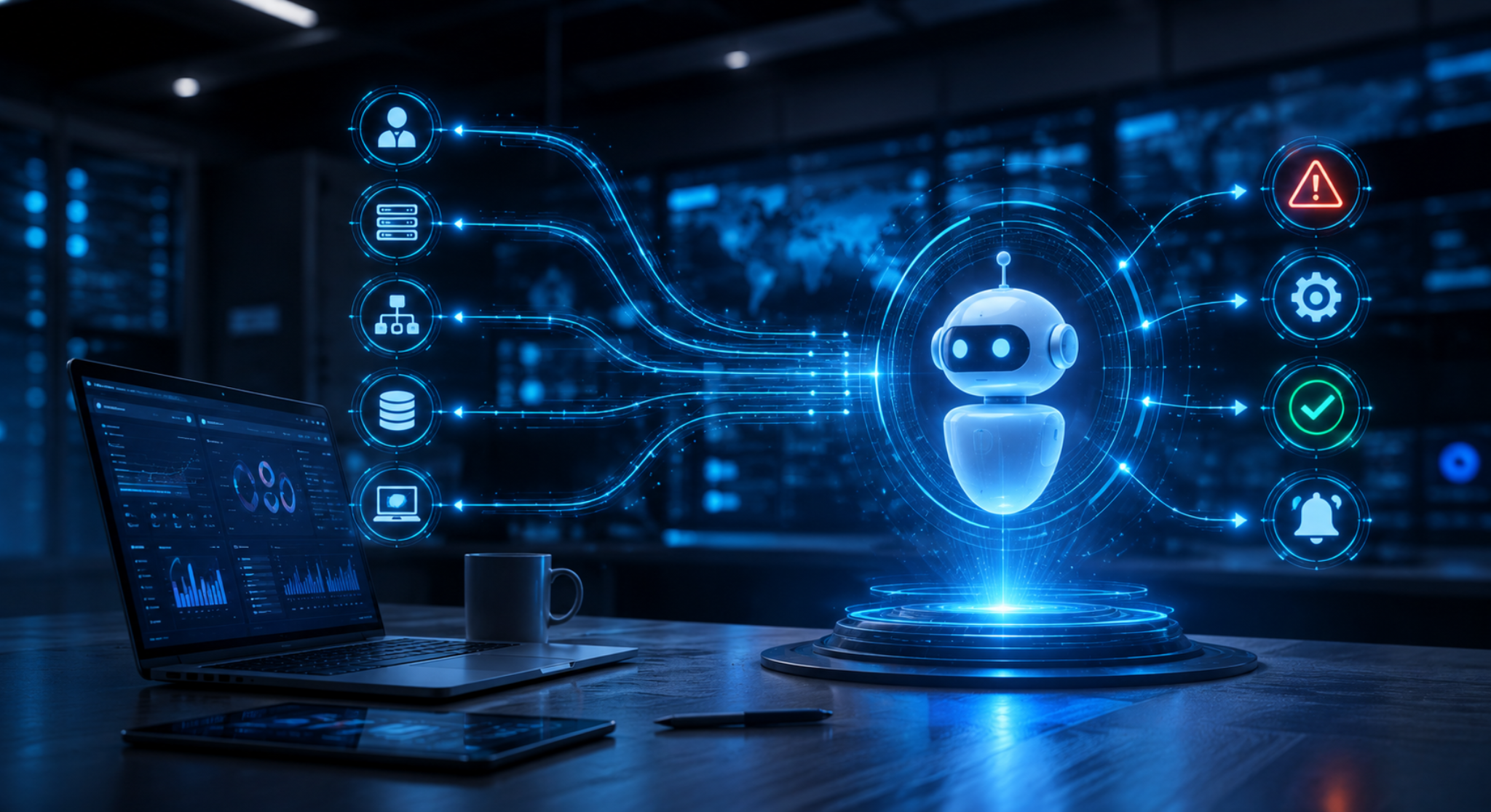
Quick Answer: AIOps (Artificial Intelligence Operations) is all about applying machine learning to IT operations data. It helps you detect, diagnose, and sometimes fix incidents before human teams get involved. AIOps works best for monitoring logs, metrics, and alerts across your cloud infrastructure and catching patterns humans may miss.
Even the best Operations teams are prone to errors. Your team may think it is on track until one misconfigured check surfaces that everyone missed. Such incidents are often hidden beneath dozens of unrelated notifications that professionals easily overlook.
AIOps prevents this from happening. While it doesn’t replace your usual cloud monitoring tools, it makes them much smarter. A dedicated AIOps platform understands how your infrastructure normally behaves, correlates multiple events across cloud services, and brings up incidents that need your team’s attention.
Your Operations team can benefit more from better incident correlation than simply adding more monitoring tools.
AIOps tools use machine learning to analyze your log streams, metric time series, API health checks, and infrastructure events to prioritize incidents. They also identify potential root causes and automate initial remediation steps.
Global industry experts are putting their bets on AIOps to improve modern cloud operations. From startups to large-scale enterprises, organizations of all scales can use it to improve incident response and reduce operational noise.
The Real Problem AIOps Solves
The biggest achievement of AIOps is not reducing downtime, but alert overload.
Most organizations assume that detecting incidents quickly is the biggest operational challenge. It actually isn’t.
Identifying which incident alert deserves your immediate attention is harder, especially when dozens of monitoring systems are reporting events simultaneously. Traditionally, organizations would resort to solutions like expanding on-call rotation, purchasing a new observability platform, or writing complex alert rules.
All these approaches demand more operational effort.
An AIOps platform does things differently. It doesn’t generate more alerts. Instead, it analyzes existing alerts with machine learning monitoring and automatically identifies the ones representing the same incident.
This way, your Operations team can spend less time sorting notifications and more time resolving the problems.
AIOps is perfect for organizations handling large-scale cloud infrastructure management and complex DevOps AI tools. You need not replace your existing observability platform. AIOps will learn how your systems behave and build intelligence on top of it.
Generating Priorities Over Traditional Monitoring
Traditional monitoring tools trigger alerts when a metric crosses a threshold you set manually. An AIOps tool sits on your existing monitoring stack. It applies machine learning capabilities to your income stream logs, metrics, traces, and alerts.
AIOps doesn’t react to every threshold breach. It builds baseline behavior models for your infrastructure. It does this using operational history from platforms like Datadog, New Relic, Splunk, Salesforce Event Monitoring, and more.
For example, imagine your Salesforce environment.
A nightly batch process creates a temporary API rate-limit warning while syncing your customer records. Traditional monitoring tools would report these warnings every night as the pre-defined threshold breaches.
AIOps doesn’t do this.
It realizes that such behavior is normal during scheduled batch processes. However, if it sees the same API warning during a working day, it will identify the event as unusual and raise its priority for investigation.
This is how AIOps understands context.
Cross-System Correlation Better Than Humans
Cross-system correlation is all about linking a symptom in one service to its root cause in another.
Modern cloud apps have dozens of microservices, databases, APIs, message queues, and third-party platforms. When an incident occurs, your Engineer will see different alerts coming from Slack, Microsoft Teams, or another observability platform.
AIOps, on the other hand, sees the entire timeline.
Suppose you have a payment app running on Kubernetes. A pod starts to fail health checks. In no time, the message queue starts building up. Soon, customer-facing APIs start returning errors.
A traditional monitoring tool would generate three different alerts for three different systems. AIOps would correlate them into a single incident with a potential propagation path.
This lets your Engineers get to the root cause instead of dealing with symptoms.
How LogiQuad Implements AIOps For Your Cloud And Salesforce Operations
At LogiQuad, we offer personalized AIOps implementation services to enhance your IT operations and empower your team with new-age tools.
Our services include a three-layer framework your cloud teams can easily understand and discuss with stakeholders:
- Data Ingestion Layer: It deals with connecting logs, metrics, traces, and events from AWS, Azure, Datadog, Splunk, New Relic, and Salesforce Event Monitoring into a unified observability pipeline.
- ML Correlation Engine: It involves training machine learning models on your organization’s baseline operational behavior. This lets the platform recognize anomalies, correlate incidents, and generate root-cause hypotheses instead of isolated alerts.
- Automated Response Layer: This layer configures intelligent alert routing, runbook automation, incident prioritization, and integration with suitable collaboration tools.
Your Cloud Operations teams will receive a repeatable implementation model. It will also help Salesforce Admins and DevOps Engineers work from a single operational picture.
Our end-to-end AIOps implementation proves how the biggest improvement to your cloud operations isn’t just about faster incident response. Your teams spending less time deciding if an alert matters and more time resolving issues genuinely affecting the end users creates a bigger impact.
It is high time you outsource these capabilities to smart machine learning tools.
Schedule a personalized AIOps assessment to boost your cloud operations and stay ahead of the curve.